


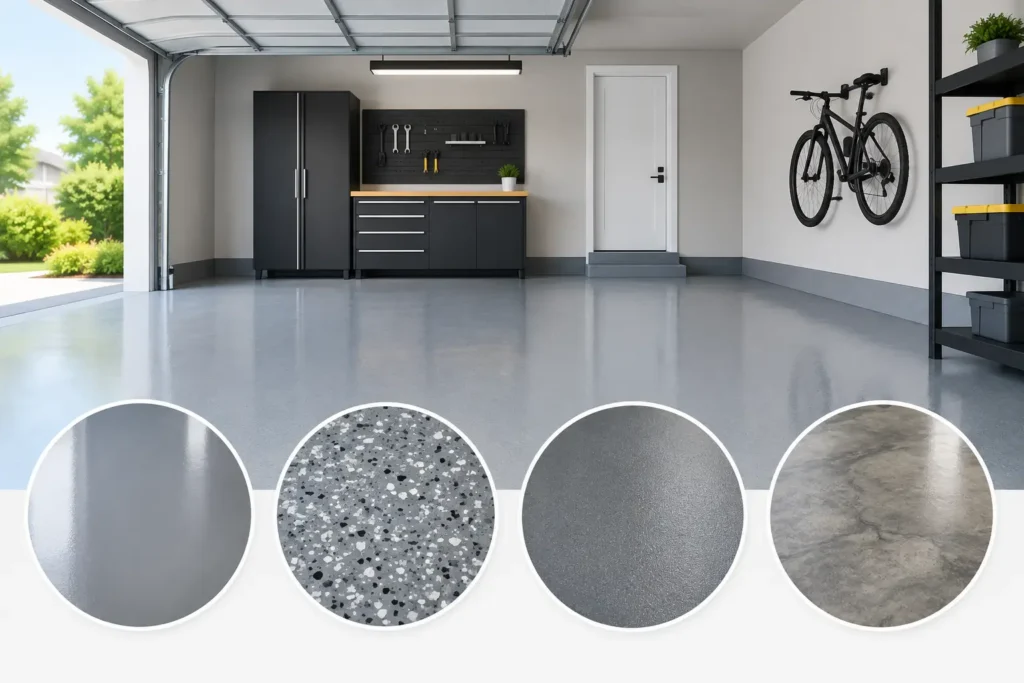

A warehouse floor takes more punishment than almost any other surface in a commercial building. Forklifts grind in grit, pallet jacks concentrate weight on small wheels, spills attack the slab, and constant traffic exposes weak finishes quickly. The best coatings for warehouse floors are not chosen by appearance alone. They must match the condition of the concrete, the work performed in the space, and the downtime your operation can realistically allow.
A professionally coated floor can improve durability, simplify cleaning, create safer walkways, and give a facility a more organized, professional appearance. The wrong system can peel, blister, or wear through early, creating another shutdown and another repair bill. The best choice depends on the job.
What Warehouse Floor Coatings Need to Handle
Before selecting a coating, look at what the floor faces during a normal week. A light storage warehouse with foot traffic has very different needs than a loading area with propane forklifts, metal-wheeled carts, battery charging stations, and frequent washdowns.
Traffic load is usually the first consideration. Forklift lanes, receiving docks, staging zones, and high-turn areas need greater film thickness and abrasion resistance than low-use storage sections. Chemical exposure matters as well. Oils, hydraulic fluids, cleaners, salt, solvents, and battery acid can damage standard paint systems.
Moisture is another deciding factor. Concrete can hold moisture vapor even when it looks dry on the surface. If that vapor is not tested and addressed, a coating may lose adhesion and fail from below. Cracks, spalling, old coatings, and contaminated concrete also need repair before a new finish is applied.
Best Coatings for Warehouse Floors by Application
There is no single coating that suits every warehouse. The systems below are widely used because each solves a different operational problem.
Epoxy Coatings for General Warehouse Use
Epoxy is one of the most common choices for warehouse floors. It forms a hard, durable surface that stands up well to vehicle traffic, impacts, many chemicals, and routine cleaning. It is a practical fit for distribution areas, storage spaces, maintenance rooms, and facilities that need a clean, uniform finish.
A high-build epoxy can also help level minor surface imperfections and provide a thicker protective layer than ordinary floor paint. Color flakes, safety lines, and designated pedestrian zones can be incorporated into the system for better organization.
Epoxy does have limits. It can yellow when exposed to strong sunlight, so it is not always the best finish near large loading doors or windows. It also requires careful surface preparation and controlled curing conditions. If the slab has active moisture issues, an appropriate moisture-mitigation primer may be necessary before epoxy is applied.
Polyaspartic Coatings for Faster Turnaround
Polyaspartic coatings are often selected when downtime is a major concern. They cure much faster than conventional epoxy, allowing some floors to return to service in a shorter window. They also offer strong resistance to UV exposure, making them a good choice for areas with daylight exposure or transitions between interior and exterior work zones.
This system provides good abrasion and chemical resistance, along with an attractive finish. It can be used as a topcoat over epoxy or as part of a complete coating system, depending on the substrate and performance requirements.
The trade-off is cost and installation timing. Polyaspartic materials cure quickly, which leaves less room for error during application. Proper mixing, coverage rates, and experienced installers are essential. Fast curing is valuable, but it does not replace the need for concrete preparation.
Urethane Cement for Wet and High-Heat Areas
Urethane cement is one of the strongest options for demanding industrial environments. It performs especially well where floors see thermal shock, frequent washdowns, moisture, steam, food-processing conditions, or aggressive chemical exposure. Unlike many standard resin coatings, it tolerates temperature changes better and is often more forgiving over damp concrete.
For warehouses with production components, wash areas, cold storage transitions, or heavy sanitation requirements, urethane cement can be the right long-term investment. Its thicker build and durability help protect concrete from severe service conditions.
It is not necessary for every facility. A dry warehouse used primarily for boxed inventory may not need this level of performance. Because urethane cement systems can cost more and require specialized installation, they are best reserved for areas where their strengths will be used.
Polyurethane Topcoats for Wear and UV Protection
Polyurethane is commonly used as a protective topcoat over epoxy. It adds abrasion resistance, flexibility, and better color stability in sunlit areas. It can also improve resistance to scratches and certain chemicals, extending the service life of the epoxy layer below.
A polyurethane topcoat is a smart addition in busy forklift lanes, showroom-adjacent warehouse spaces, and facilities where appearance matters alongside performance. It is generally not used alone as the primary build layer over rough concrete because it is thinner than epoxy or urethane cement.
MMA Coatings for Critical Shutdown Windows
Methyl methacrylate, often called MMA, is a specialty flooring system known for very rapid curing. It can be installed in colder conditions than some alternatives and may allow a facility to reopen within hours rather than days. This makes it useful for operations that cannot afford an extended closure.
MMA has a strong odor during installation and requires careful ventilation, safety controls, and professional handling. It is a capable option, but it is not the default choice for a standard warehouse. It is most valuable when speed, low-temperature installation, and minimal downtime outweigh the added complexity.
A Simple Way to Match the Coating to the Facility
For a dry warehouse with normal forklift traffic, a high-build epoxy system with a polyurethane or polyaspartic topcoat is often a reliable balance of cost, durability, and appearance. For receiving areas with direct sunlight or a short closure window, polyaspartic may be worth the added investment.
For wet process areas, frequent washdowns, temperature swings, or harsh chemical exposure, urethane cement deserves serious consideration. If the operation must reopen almost immediately, MMA may provide the right schedule advantage.
Do not overlook slip resistance. A glossy floor can look clean but become hazardous when water, oil, or fine dust is present. Anti-slip aggregate can be added to coatings in ramps, loading zones, entrances, wash areas, and pedestrian walkways. The amount of texture should be tailored to the area. Too little may not improve safety enough; too much can make cleaning harder and increase wear on equipment tires.
Surface Preparation Determines Whether the Coating Lasts
Even the best coating will fail when applied over weak, dirty, or poorly prepared concrete. Preparation is where a quality warehouse floor project is won or lost.
Professional installers begin by inspecting the slab for cracks, damaged joints, oil contamination, failing prior coatings, and moisture concerns. Mechanical grinding or shot blasting is typically used to create the correct surface profile for adhesion. Acid etching alone is rarely enough for a heavy-duty warehouse system.
Cracks and spalled areas should be repaired before coating begins. Expansion joints are treated differently from static cracks because they are designed to move. Coating directly over active joints without the correct joint filler or detail can lead to premature cracking.
The floor must also be clean. Oil, tire residue, dust, curing compounds, and adhesive residue can interfere with bonding. This preparation work may not be the most visible part of the project, but it protects the investment in the finished coating.
Plan the Installation Around Warehouse Operations
A coating project should be planned around traffic patterns, inventory, loading schedules, and cure times. In many facilities, the most practical approach is to complete the work in phases. One section can remain operational while another is prepared and coated.
Clear communication matters. Equipment, pallets, shelving, and stored materials may need to be moved before work starts. Facility managers should identify critical access routes, emergency exits, dock doors, and areas that cannot be taken offline. A professional contractor can build those requirements into the project scope instead of treating them as last-minute obstacles.
It is also wise to think beyond the main floor area. Safety markings, traffic arrows, aisle lines, pedestrian crossings, wall protection zones, and equipment pads can make the finished space safer and easier to manage. These details help turn a coating project into a practical facility upgrade.
Choose Performance Before Color
Gray is popular for warehouse floors because it hides dust and tire marks reasonably well, but color should be the final decision, not the first. Start with the slab condition, traffic level, chemical exposure, moisture risk, slip-resistance needs, and available downtime. From there, select a coating system that gives the floor the protection it needs without paying for performance the facility will never use.
A warehouse floor should support the work happening above it every day. When the coating is matched to the operation and installed over properly prepared concrete, it delivers a cleaner, safer surface that is built for the long haul.